Plain-language summary
- What it solves
- Estimating the probability of Etna activity over the coming hours and days, while stating how reliable the estimate is.
- Who it can serve
- Anyone following the volcano, and anyone studying probabilistic forecasting on public data.
- What it produces
- A card with the probabilities and one with the model's performance.
To measure honestly whether seismic, thermal and tremor data add value over event history, without imitating an official forecast.
3 · What it produces
Current probabilities and a separate model-metrics card.
The first image shows 24-hour and 5-day horizons, the selected source and degraded modalities. The second exposes Brier score, baselines, candidate models and the matured track record.
4 · How it works
From geophysical data to the selected probability.
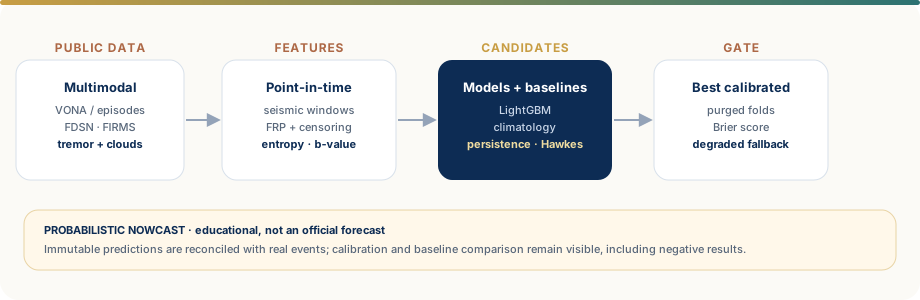
5 · Data used
| Source | Information | Main features | Control |
|---|---|---|---|
| INGV VONA / episodes | event history | days since episode, 30/90-day counts, Hawkes | label audit and immutable records |
| FDSN | seismicity and tremor | counts by radius, Benioff, depth, RMS, slope, entropy, Hurst | point-in-time cutoff and valid hours |
| NASA FIRMS | thermal anomalies | FRP, counts, slope and days since hotspot | cloud censoring and NaN beyond coverage |
| Open-Meteo | cloud cover | valid days and censored ratio | observed zero separated from missing |
Physical signals, complexity and regime
Aki–Utsu b-value, depth migration, Benioff strain, regional stress, FRP per clear day, permutation entropy, Hurst-DFA, HF/VT ratio and episode-regime features.
ML against strong baselines
Calibrated elastic net and LightGBM by modality and combination; climatology, persistence and Hawkes process as baselines. The modality gate selects the best-calibrated source by fold and declares fallback use.
Current evidence: event history/Hawkes is still frequently selected. The incremental value of seismic, thermal and tremor modalities has yet to prove stable out of sequence; the workflow publishes this negative result rather than hiding it.
Purged walk-forward
Indivisible episodes, temporal embargo, frozen holdout, Brier score, calibration and baseline comparison. Forecasts are registered ex ante and reconciled when outcomes mature.
Educational, not operational
Public data may be incomplete or delayed and the positive sample is limited. This is not an INGV bulletin and must not be used for safety or civil-protection decisions.
Possible applications of the pattern
Multimodal nowcasting with fallback and scorecard.
The pattern can support rare-event research when modality availability changes and a strong baseline must remain competitive and visible.
Transferable components
- daily point-in-time table
- quality and censoring masks
- modality gate and graceful degradation
- immutable forecasts and reconciliation
Research questions
- real incremental value of modalities
- rare-event calibration
- episode-level stability
- drift and source completeness
Workflow technical dossier
IMPLEMENTEDDescribes repository behaviour.PROVISIONALScientific skill remains dependent on data completion and matured sample size.
Probabilistic AI/ML, data engineering and MLOps.
The repository prioritises temporal correctness, baselines, calibration and failure modes over complexity for its own sake.
Architecture and data
- Full historical backfill separated from cache-aware incremental updates.
- Feature tables in Parquet/Pickle, versioned forecast records and an HTML dashboard.
- HTTP acquisition, HTML/PDF parsing and FDSN; cache saved even after degraded runs.
Features and models
- 1/3/7/14/30-day windows, geographic distances and coverage features.
- LightGBM/scikit-learn, calibrated candidates and Hawkes baseline.
- Blend and per-horizon gate with documented source choice.
Validation and governance
- Purged walk-forward, embargo and holdout; Brier score and matured live scorecard.
- Offline synthetic self-test, pytest, Ruff, workflow YAML and cold-cache runtime test.
- Educational disclosure, INGV as authoritative source and independent bilingual posts.
Stack
- pandas, NumPy, SciPy, PyArrow, scikit-learn and LightGBM.
- requests, Beautiful Soup, pypdf and optional ObsPy for tremor.
- Pillow, HTML/CSS, GitHub Actions and AT Protocol.
10 · Runtime
Scheduled runs and event-time activation.
- Status: active · educational · declared degradation
- Frequency: Monday, Thursday and Sunday; additional event runs
- Output: probability card, metrics and dashboard
11 · Technical detail
How is the Brier score calculated?
For each probability forecast p and observed outcome y ∈ {0,1}, the contribution is (p − y)²; the Brier score is the mean over matured cases. Lower is better. Brier Skill Score compares the model with a baseline: BSS = 1 − BS_model / BS_baseline; it is positive only when the model truly improves on that baseline.
Why use Hawkes?
It models temporal self-excitation and provides a strong baseline: the multimodal model must demonstrate incremental value out of sequence.
What is the modality gate?
It compares candidate sources across folds and selects the best-calibrated one, including a baseline when modalities add no value or are incomplete.
Main failure mode
Treating an educational probability as an alert, or confusing good calibration with event certainty.
See probabilities and metrics in the same post.
The Publications gallery lets readers move between the two localised images.
Potential transferability
Have a problem similar to Etna Forecast?
A first discussion can start from the objective, available data and success criterion without sending confidential information. A result observed here is not assumed to transfer automatically to another context.