Plain-language summary
- What it solves
- Public weather forecasts are accurate but hard to compare across different cities.
- Who it can serve
- Anyone planning outdoor activities in several places, and anyone teaching how to read weather data.
- What it produces
- A grid comparing the cities, and a detail card for each one.
Make several weather factors readable without making a diagnosis or predicting an individual symptom.
3 · What it produces
Multi-city grid and a D+1–D+3 detail card.
How to read the latest output: A high value means several adverse weather factors occur together; it does not measure personal pain and is not a medical forecast.
4 · How it works
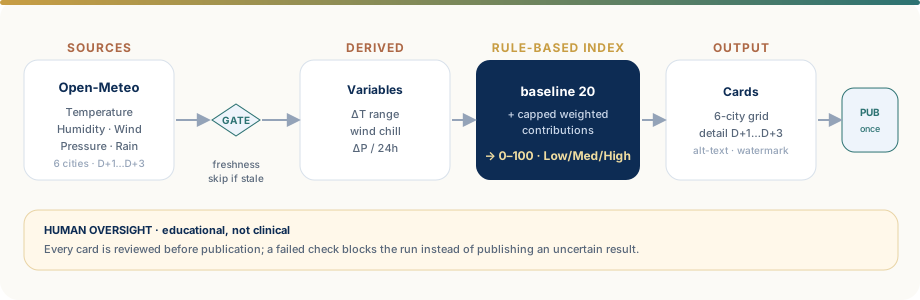
From sources to output.
5 · Data used
| Source | Variable | Frequency | Limitation |
|---|---|---|---|
| Open-Meteo | Temperature, humidity, wind, pressure, rain | Every run | Public API; missing values are possible |
Models and rules
Rule-based index with capped weighted contributions, wind chill and 24-hour pressure change.
Controls
Freshness, missing values, exact and visual hashes, UTC watermark and publication blocking when inputs are incomplete.
Results and metrics
Run continuity, missing data caught and duplicates prevented. No clinical performance metric is claimed.
Limits
No causal claim; individual response is not modelled; educational use only.
Possible applications of the pattern
Rule-based weather index
Possible applications: transparent indices for comfort, operational risk, maintenance or multi-site prioritisation. Thresholds require domain validation and must not be presented as clinical inference.
Transferable components
- Open-Meteo and local timezones
- derived weather features
- weighted rules with saturation
- multi-city and D+1–D+3 cards
Research questions
- weight sensitivity
- geographic stability
- comparison with a naïve index
- uncertainty communication
Workflow technical dossier
IMPLEMENTEDDescribes behaviour present in the workflow.EXTENSIONIndicates a possible check or evolution, not an operating feature.
Implementation detail and assessment criteria.
This section connects the visible output to data-engineering, modelling, validation and delivery choices present in the repository.
Architecture and data
- Multi-city Open-Meteo acquisition with local time zones and HTTP retry.
- Daily CSV history and JSON publication state.
- Separation of index calculation, recommendations, graphics, PDF and social publisher.
Features and methods
- Tmax−Tmin range, thresholded wind, wind chill, humidity, rain, 24-hour pressure change and absolute pressure.
- Deterministic score with a 20-point baseline, capped contributions and Low/Medium/High thresholds.
- Advice engine with categories, priority, deduplication and trend versus a 7-day mean.
Validation and failure modes
- Scenario and deterministic-output tests; missing-data and date checks.
- Exact and visual hashes prevent duplicates; watermark and alt text are separate.
- No clinical label: the system does not claim medical accuracy or causality.
Runtime and delivery
- Python 3.11, requests, tenacity, matplotlib, Pillow, ReportLab, pytz and atproto.
- GitHub Actions with dispatch, schedules, artifacts and strict/non-strict Bluesky modes.
10 · Operating timeline
Operating timeline
- Status: Active · educational
- Frequency: Monday, Wednesday and Friday
- Page updated: July 2026
11 · Technical detail
Method and assumptions
Rule-based index with capped weighted contributions, wind chill and 24-hour pressure change.
Main failure modes
No causal claim; individual response is not modelled; educational use only.
Publication governance
Freshness, missing values, exact and visual hashes, UTC watermark and publication blocking when inputs are incomplete.
See real outputs
The Publications page reads the public Bluesky feed and shows up to three recent runs, including multiple images in one post.
Potential transferability
Have a problem similar to Weather automation?
A first discussion can start from the objective, available data and success criterion without sending confidential information. A result observed here is not assumed to transfer automatically to another context.