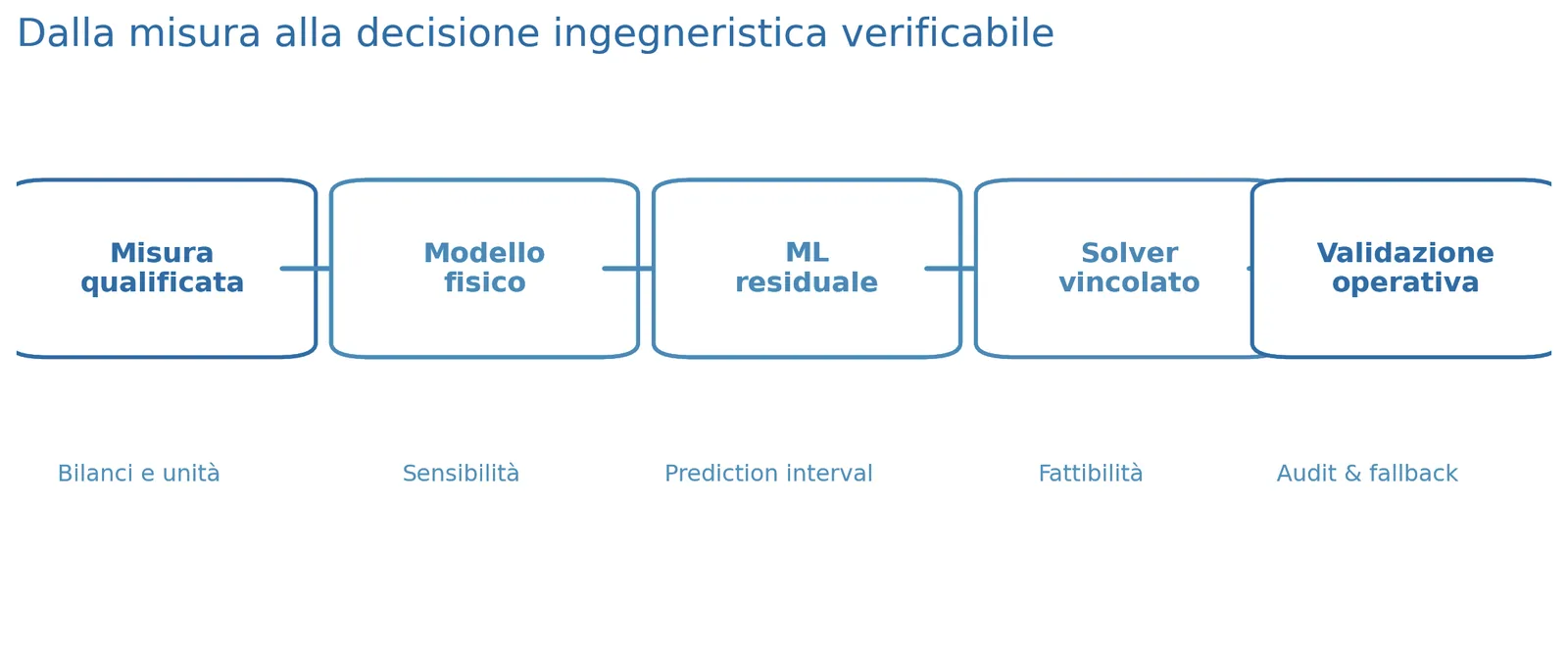
Two levels: basic and advanced
In plain words
Picture an app telling you: “70% chance of rain tomorrow.” Useful, but it doesn’t tell you whether to take an umbrella. That depends on you: how much you mind getting wet, how annoying it is to carry one, where you’re going. AI models work the same way: they produce estimates, not choices.
That’s why, when we build a workflow, the first question isn’t “which algorithm?” but “which decision should this support?”. A great forecast tied to the wrong decision is useless; a modest forecast tied to a concrete choice can save time, energy and money.
Going deeper
In engineering the full chain is: qualified measurement, model (physical, statistical or hybrid), estimate with uncertainty, operating constraints, decision, verification. Each link fails in its own way: unvalidated data, a model used outside its domain, intervals that are too narrow, forgotten constraints, no check afterwards.
Formally, a decision minimises an expected cost: for each possible action, the cost under each state of the world is weighted by its estimated probability. Two practical consequences follow. First, you need calibrated probabilities, not just labels. Second, the intervention threshold depends on costs, not on accuracy. A model with lower accuracy but reliable probabilities can lead to better decisions than a “more accurate” but overconfident one.
E[C(a)] = Σⱼ P(sⱼ | x) · C(a, sⱼ) → choose the action a with the lowest expected costKey takeaway: Define the decision and the cost of being wrong first; choose the model second.